Plastic materials: FR-4/G10 Plastic Fasteners

FR-4 is a glass-epoxy laminate, with continuous woven glass fabric woven with an epoxy resin.
FR-4 vs. G10
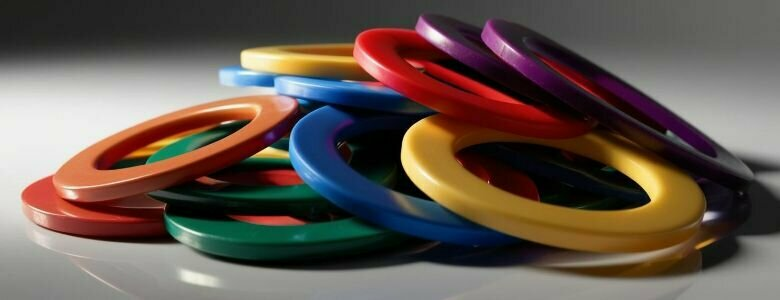
FR-4 Plastic Washer
One important item to note, before we begin: The National Electrical Manufacturers Association (NEMA), the regulating authority for FR-4 and other insulating laminate grades, has grade designations for glass epoxy laminates including: G10, G11, FR4, FR5, and FR6. Of these grades, the FR4 is most widely used today. G-10, the predecessor to FR-4, lacks FR-4’s self-extinguishing flammability characteristics and is not as commonly used, except in applications where thermal destruction of the material is desirable. Hence, FR-4 has replaced G10 in most applications, even as manufacturers and distributors (like E & T) refer to FR-4 as FR-4/G10.
Properties of FR-4
General Properties
Typical physical and electrical properties of FR-4 are expressed by LW (lengthwise, wrap yarn direction), and CW (crosswise, fill yarn direction). LW and CW refer to fiber orientations that are perpendicular to each other.
Parameter Value
Specific gravity/density 1.850 g/cm3 (3,118 lb/cu yd)
Water absorption −0.125 in < 0.10%
Temperature index 140 °C (284 °F)
Thermal conductivity, through-plane 0.29 W/mK, 0.343 W/mK
Thermal conductivity, in-plane 0.81 W/mK, 1.059 W/mK
Rockwell hardness 110 M scale
Bond strength > 1,000 kg (2,200 lb)
Flexural strength (A; 0.125 in) – LW > 440 MPa (64,000 psi)
Flexural strength (A; 0.125 in) – CW > 345 MPa (50,000 psi)
Tensile strength (0.125 in) LW > 310 MPa (45,000 psi)
Izod impact strength – LW > 54 J/m (10 ftlb/in)
Izod impact strength – CW > 44 J/m (8 ftlb/in)
Compressive strength – flatwise > 415 MPa (60,200 psi)
Dielectric breakdown (A) > 50 kV
Dielectric breakdown (D48/50) > 50 kV
Dielectric strength 20 MV/m
Relative permittivity (A)
Relative permittivity (D24/23)
Dissipation factor (A)
Dissipation factor (D24/23)
Dielectric constant permittivity 4.70 max., 4.35 @ 500 MHz, 4.34 @ 1 GHz
Glass transition temperature Can vary, but is over 120 °C
Young’s modulus – LW 3.5×10⁶ psi (24 GPa)
Young’s modulus – CW 3.0×10⁶ psi (21 GPa)
Coefficient of thermal expansion – x-axis
Coefficient of thermal expansion – y-axis
Coefficient of thermal expansion – z-axis
Poisson’s ratio – LW
Poisson’s ratio – CW
LW sound speed 3602 m/s
SW sound speed 3369 m/s
LW Acoustic impedance 6.64 MRayl
Super Strong Plastic Fastener Material
Because of the combination of continuous woven glass fabric and interwoven epoxy resin, FR-4 exhibits extremely high strength-to-weight ratios. For example, FR-4 plastic fasteners, with a tensile strength of 45,000 psi (310 MPa), compare favorably to brass and aluminum fasteners. Brass (specifically, standard grade C3600) is 50,000 psi (345 MPa), while aluminum (standard grade 6463-T6) has an ultimate tensile strength of 35,000 psi (241 MPa). Heck, even structural steel has an ultimate tensile strength of 40,000 psi . Wow.
Flame Resistance
FR actually stands for “Flame Resistant”, so you can bet FR-4 plastic fasteners are flame resistant. According to the UL 94 test which describes the plastic as “self-extinguishing”, FR-4 epoxy resin uses bromine to give the material a UL 94 V-0 flammability rating. Bromine is an oxygen scavenger, and is added to G10 to create FR-4. With bromine added, FR-4 receives the highest flame retardant rating on the UL 94 V index.
Waterproof
With a water absorption rate of almost zero percent, FR-4 is waterproof. Additionally, FR-4 is saltwater resistant, proving it to be an ideal use in marine use components and equipment, such as boats and fishing rods. FR-4 is so waterproof that it has been used in deep-sea communications cabling.
Electrical Characteristics
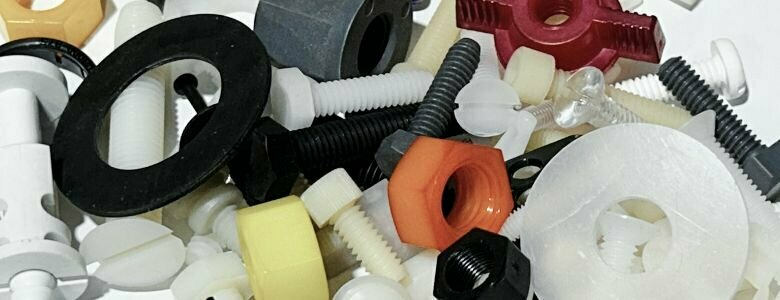
FR-4 exhibits outstanding electrical insulating characteristics and dimensional stability – mainly because water absorption is virtually non-existent and that it is flame retardant. Because of its electrical insulation properties, FR-4 is used heavily in electrical circuit boards; it can also be machined into screws, nuts, bolts, washers, spacers, and other shapes.
Summary
When choosing components and fasteners for manufacturing and production, consider the application, the environment of the finished products, and the characteristics of the materials available. Plastics, and especially some of the advanced composite materials, make a great choice for many applications and offer exceptional strength and resistance to wear.
While FR-4/G10 plastic fasteners are a fine choice, they are not used in every application. If you have any questions on the properties of plastic fasteners or specifically about FR-4 plastic fasteners and their use within your application, please do not hesitate to contact us. We’re here to help.