PEEK screws are made from polyetheretherketone, a high-performance thermoplastic. It combines strength, chemical resistance, and electrical insulation at a maximum service temperature of about 480°F (250°C). We supply PEEK plastic screws and bolts in two grades, unfilled and 30% glass-filled, and quote each order based on the size and head style you specify.
Why Choose PEEK Fasteners
PEEK is a semi-crystalline thermoplastic selected for applications that need high temperature resistance, chemical resistance, and dimensional stability in one material. Its main properties:
- Temperature: A standard unfilled PEEK grade is rated for continuous electrical use at 500°F (260°C) under UL 746B, and PEEK melts at 649°F (343°C). Strength declines as temperature rises, most sharply around 289°F (143°C), PEEK's glass transition point. Published data for unfilled PEEK shows flexural strength falling from 23,900 psi at room temperature to about 5,500 psi at 302°F (150°C).
- Chemical resistance: Both unfilled and glass-filled PEEK resist aggressive chemical environments. PEEK fasteners also have a very high resistance to high-energy radiation.
- Strength and weight: Resin data sheets describe PEEK's balance of stiffness, tensile strength, and impact strength as uncommon in a single material. At a density of 1.30 g/cm³, unfilled PEEK weighs about half as much as aluminum.
- Electrical properties: PEEK is an electrical insulator, and it maintains good insulating properties over a broad temperature range.
Unfilled vs. 30% Glass-Filled PEEK
Both grades share PEEK's chemical resistance and natural beige color. The glass fiber changes strength, stiffness, heat deflection, and thermal expansion.
Unfilled PEEK is 100% polymer with no reinforcement. It's the more ductile of the two grades, so it suits applications that need strength and stiffness along with the ability to stretch before breaking.
30% glass-filled PEEK has roughly 70-85% higher tensile strength than the unfilled grade and almost three times its stiffness. Its heat deflection temperature at 264 psi rises from about 306 to 315°F (152 to 157°C) to about 600°F (315°C). It also expands far less with heat, which helps parts keep their dimensions through temperature swings. It suits higher-strength structural parts, particularly in static assemblies. The trade-off is ductility, since it stretches only about 3 percent before breaking.
Unfilled and glass-filled PEEK resins are both available in FDA-compliant food-contact grades. Glass-filled grades are also listed as sterilizable, including by steam and autoclave.
PEEK Screws and Bolts Made to Your Specification
We quote PEEK screws and PEEK bolts to your requirements. The same two grades apply whether the part is a screw threaded into a tapped hole or a bolt paired with a nut.
Include the grade, head style, drive, thread size, length, and quantity in your request, whether you need PEEK socket head cap screws, hex head bolts, or another style. Note any food contact, sterilization, color, or industry specification requirements so we can confirm a suitable resin grade. A drawing, blueprint, or sample works too. Send your specifications through our quote form, or contact our team with questions about grade selection.
How PEEK Compares to Ultem and PTFE
The table below uses our material properties charts, which report results by ASTM method. Because the resin data sheet figures above use ISO methods, the glass-filled PEEK values differ slightly between the two tables.
| Property | PEEK, 30% glass-filled | Ultem 2300, 30% glass-filled | Ultem 1000, unfilled | PTFE |
|---|---|---|---|---|
| Tensile strength | 22,800 psi | 24,500 psi (at break) | 15,200 psi | 3,000 psi |
| Heat deflection temperature at 264 psi | 600°F | 410°F | 392°F | 132°F |
| Maximum service temperature | 480°F | 342°F | 338°F | 500°F |
| Water absorption, 24 hours | 0.11% | 0.16% | 0.25% | Less than 0.01% |
| UL 94 flammability rating | V-0 | V-0 | V-0 | V-0 |
| Specific gravity | 1.49 | 1.51 | 1.27 | 2.2 |
PEEK vs. Ultem
In 30% glass-filled form, PEEK and Ultem are close in tensile strength. PEEK's heat deflection temperature is nearly 200°F higher, and its maximum service temperature is about 140°F higher. Ultem generally costs less, so it's the more economical choice when operating temperatures stay within its service range.
PEEK vs. PTFE
PTFE has a slightly higher maximum service temperature and the broadest chemical resistance of the group. Its tensile strength is about one-eighth that of glass-filled PEEK, though, and its heat deflection temperature under the 264 psi test load is 132°F. Semiconductor wet-process equipment uses both for that reason. The tanks and chemical supply systems are often made of fluoropolymers, while PEEK is used for mechanically stressed parts like wafer holders.
Industries That Use PEEK
- Semiconductor manufacturing: Unfilled PEEK is used in chip production steps such as chemical mechanical planarization (CMP) and etching. Semiconductor-grade PEEK is available, made to the industry's copy-exact quality requirements.
- Chemical processing and oil and gas: Chemical resistance and low moisture uptake make PEEK a fit for chemical processing equipment. Components made from unfilled PEEK are also used in oil and gas service.
- Aerospace: PEEK is used in both commercial and military aircraft. Its low outgassing allows use in vacuum environments, and aerospace PEEK grades meet requirements such as FAR 25.853 for flammability and MIL-P-46183.
Frequently Asked Questions
Is PEEK stronger than nylon?
In glass-filled form, the two are close. Our charts list 30% glass-filled nylon 66 at 25,000 psi tensile strength and 30% glass-filled PEEK at 22,800 psi. PEEK's advantages are heat and moisture resistance. Its maximum service temperature is 480°F against 230 to 240°F for glass-filled nylon, and it absorbs 0.11 percent water in 24 hours compared with 0.9 percent.
What are the limits of PEEK's chemical resistance?
PEEK resists a wide range of chemicals, with a few exceptions. It dissolves in concentrated sulfuric acid at room temperature, and halogens, strong acids, and some halogenated compounds and aliphatic hydrocarbons can attack it at high temperatures. Published chemical resistance guides rate PEEK against individual chemicals at temperatures such as 73°F, 212°F, and 392°F.
Is PEEK a fluoropolymer?
PEEK is a halogen-free polymer made without fluorine, which separates it from fluoropolymers such as PTFE. PTFE gets its properties from carbon-fluorine bonds, while PEEK is built from repeating ether and ketone linkages.
What colors do PEEK screws come in?
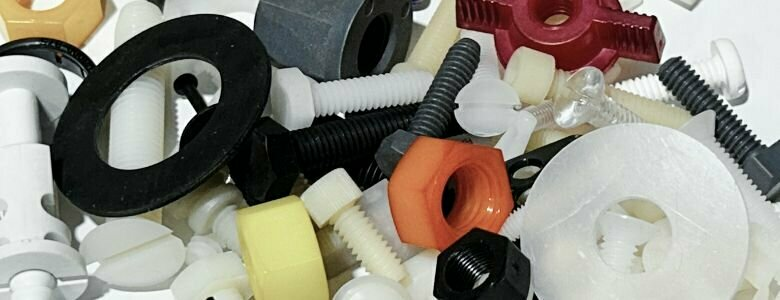
Standard PEEK is a natural beige. Black versions of the standard grades are also produced, including 30% glass-filled PEEK.
Request a Quote for PEEK Screws
To price PEEK screws or bolts for your application, send us your specifications or call 800.650.4707.